‘Globally, we are still known as an absolute A-brand’
Scroll down
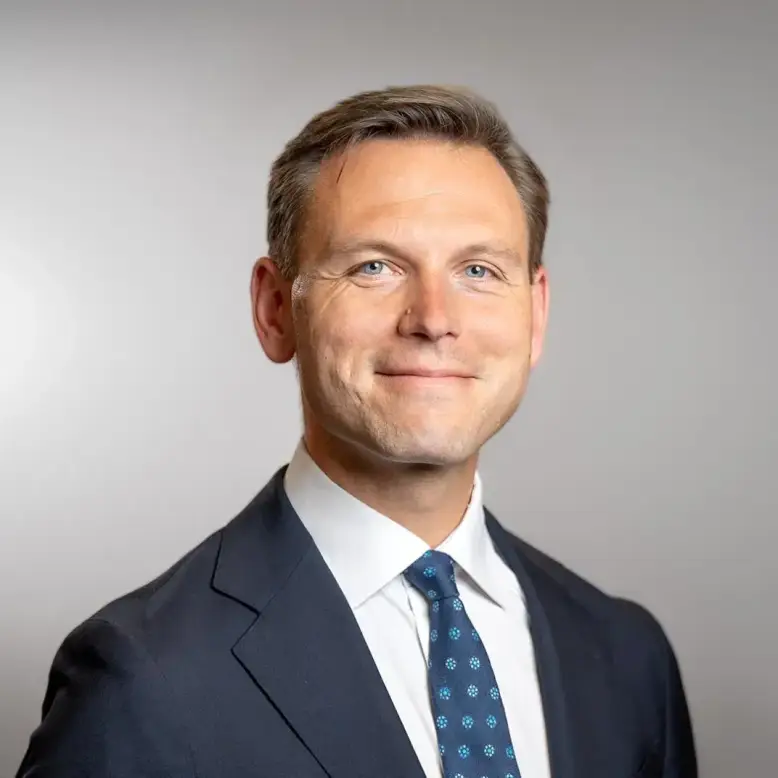
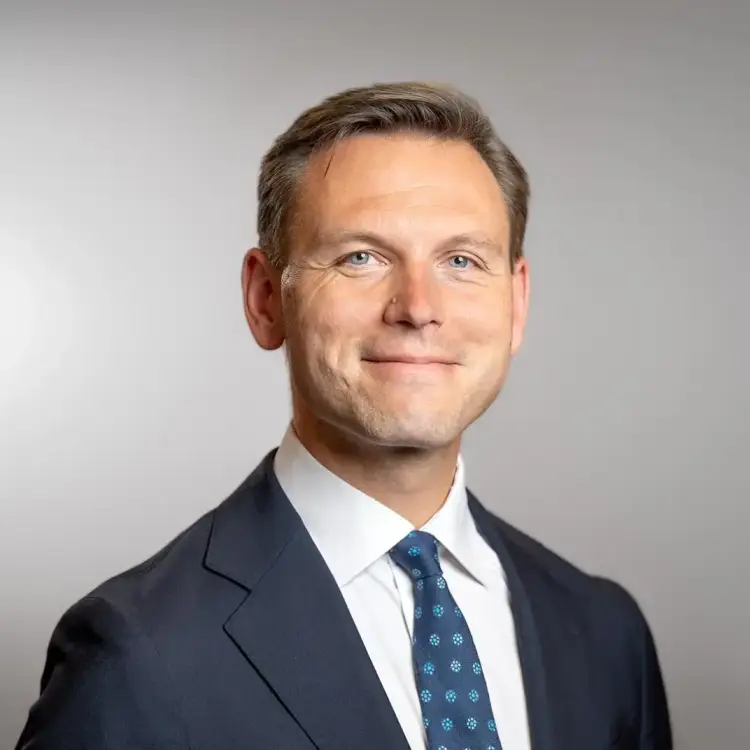
About six months after taking office as port alderman, Tim Versnel has had the opportunity to get to know the port of Rotterdam up close. What stands out to him? The international appreciation for the port of Rotterdam and its industry, but also companies’ concerns about the investment climate. In conversation withRotterdam Port Magazine, he shares his first impressions, ambitions and vision of the municipality's role as a partner of the port.
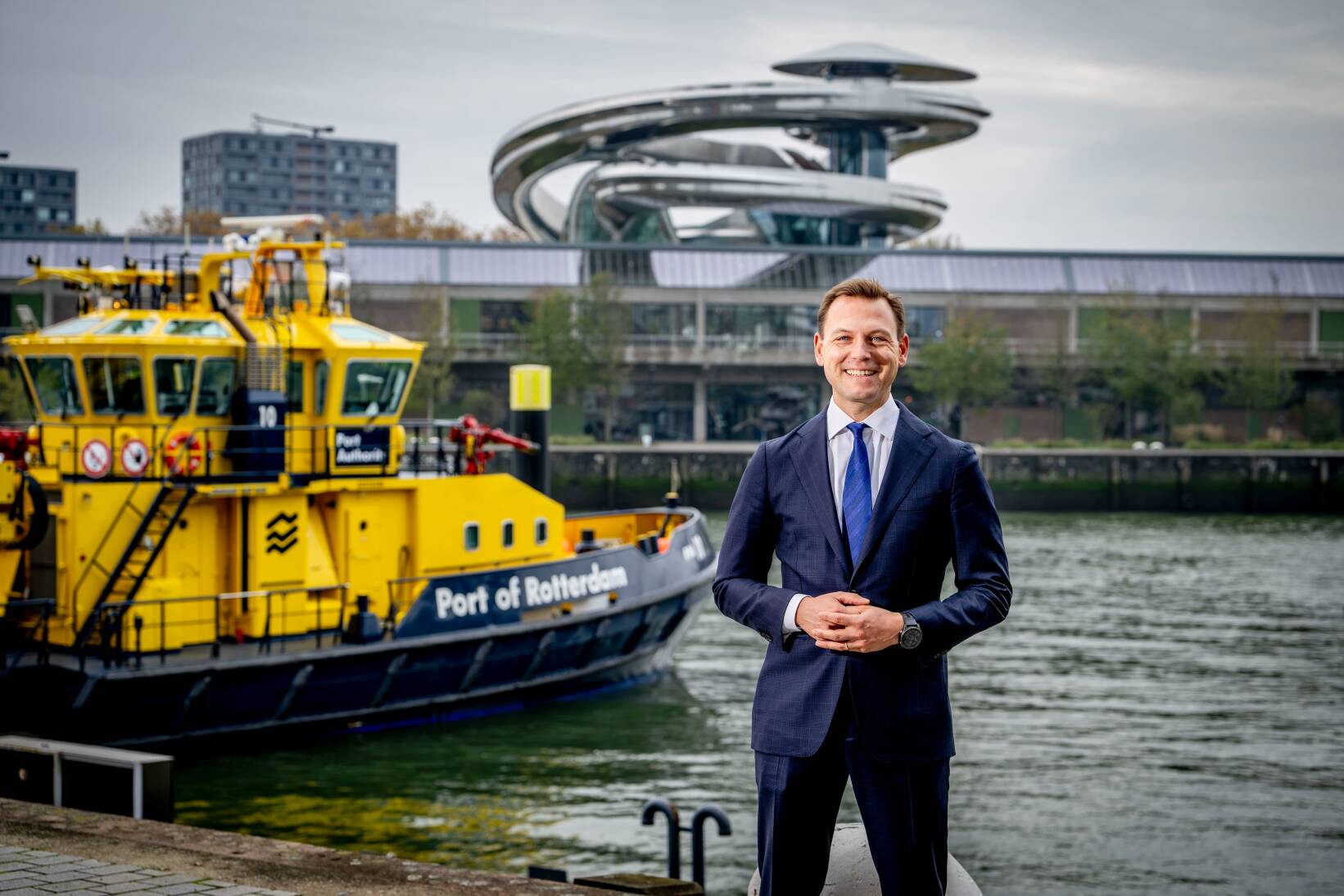
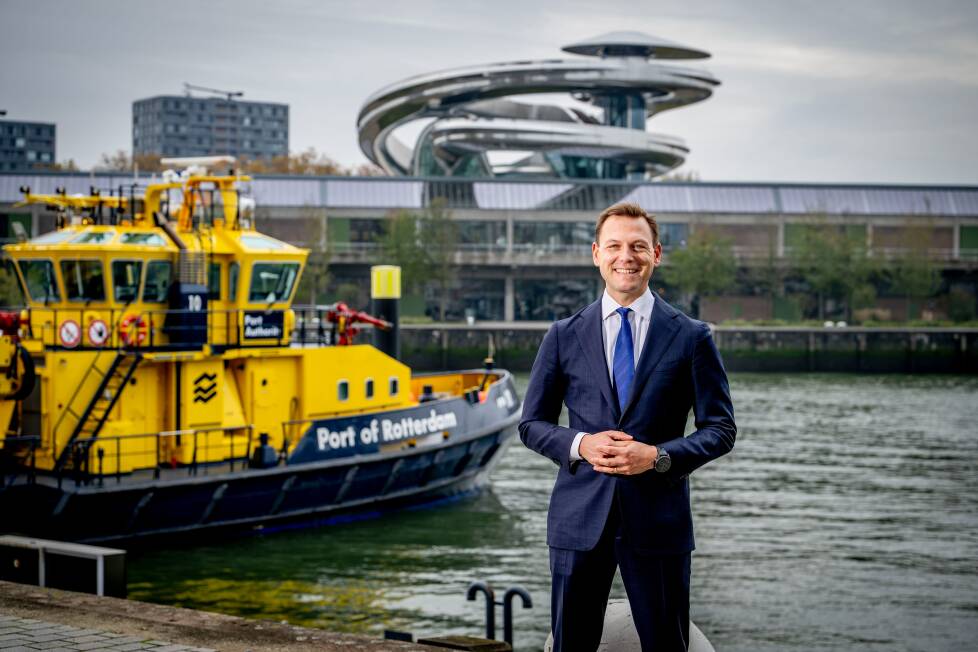
We spoke to Versnel on the day he also had a meeting scheduled with harbour master René de Vries. The programme included a short boat trip aboard the RPA 10. Once back on shore, the port alderman beams as he walks from the pontoon near Hotel New York to the quay, where he is due to record a short interview. That grin doesn't come out of nowhere: he was allowed to steer the vessel for a while. ‘Surely that was the highlight of the day,’ Versnel exclaims.
VVD member Versnel took office as alderman for the port, economy and small communities in July. Rotterdam City Hall was by no means unfamiliar territory for him before then; from 2022 until last summer, he had already served as an alderman, with work and income and the Rotterdam-Zuid National Programme in his portfolio.
‘In that role, I visited the port frequently. It's an advantage that I already knew a lot of people there,’ says Versnel. ‘Although those discussions were mainly about the labour market and staff shortages, I was also involved in the Human Capital Coalition Energy Transition. So I already knew what the port community was doing to attract new staff, albeit from a greater distance than I do now.’
And now you are focusing on the port. You’ve spoken to a lot of people and visited many places in the port. What has stood out to you the most?
‘First of all, the port is huge and diverse, of course, with so much going on. We’re talking about shipping, logistics, industry and the challenges surrounding the energy and raw materials transition. And the more you zoom in, the more impressive it gets. For example, if you look at petrochemicals: every door you open and every system you look into turns out to be more complex than you thought. In addition, I'm really struck by the high regard in which Rotterdam is held internationally.’
Can you give an example of that?
‘I noticed that during conversations on a trade mission in Hamburg. Worldwide, we are still truly known as an absolute A-brand. That made the strongest impression on me, by far. People said that it's not just about our cluster or scale, but about our people. They are experts: professional, inventive and full of humour. There are, however, concerns about the government, energy costs and permits. But at the same time, companies say: we still want to be in Rotterdam, because you have the people. When you hear that from a CEO of a company operating around the world, you know they have a basis for comparison. At the same time, they know the bottlenecks in Rotterdam.’
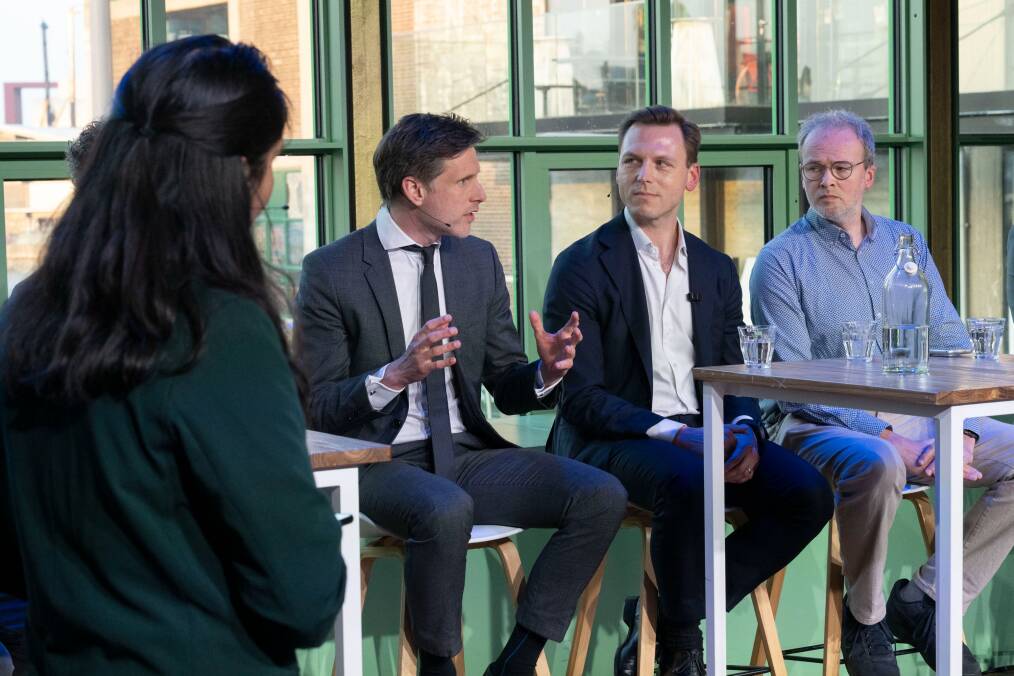
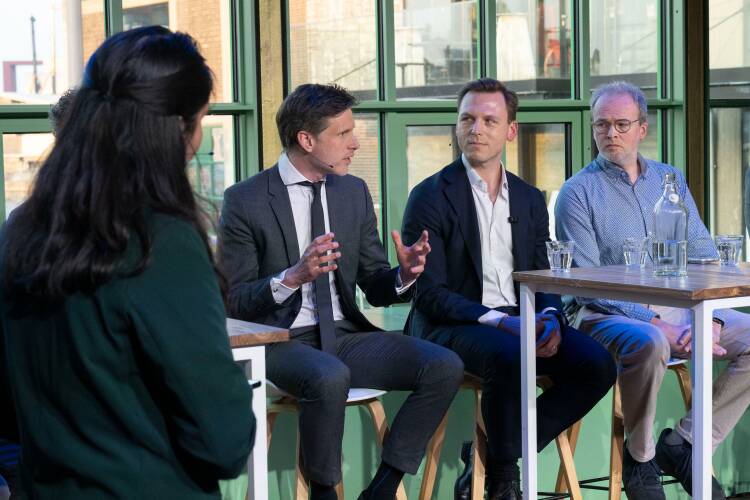
Alderman Tim Versnel (third from the left) during the Port Election Debate 2026
What concerns about these bottlenecks do you hear during conversations in the port?
‘These conversations are often very candid. Practical problems come up, such as pressing concerns about infrastructure and, consequently, accessibility. Just as often, the discussions focus on the ambition to become more sustainable and keep innovating, but the preconditions must be in place to make that possible. Companies are concerned about high energy costs, unfair international competition and a lack of a level playing field in Europe. I think our companies are so good at what they do that they can withstand quite a bit of unfair competition. However, the balance has now become seriously distorted. That’s why I am also calling for better protection of our market and our companies in Brussels. That’s inevitable — and quite a tough message for me as a liberal.’
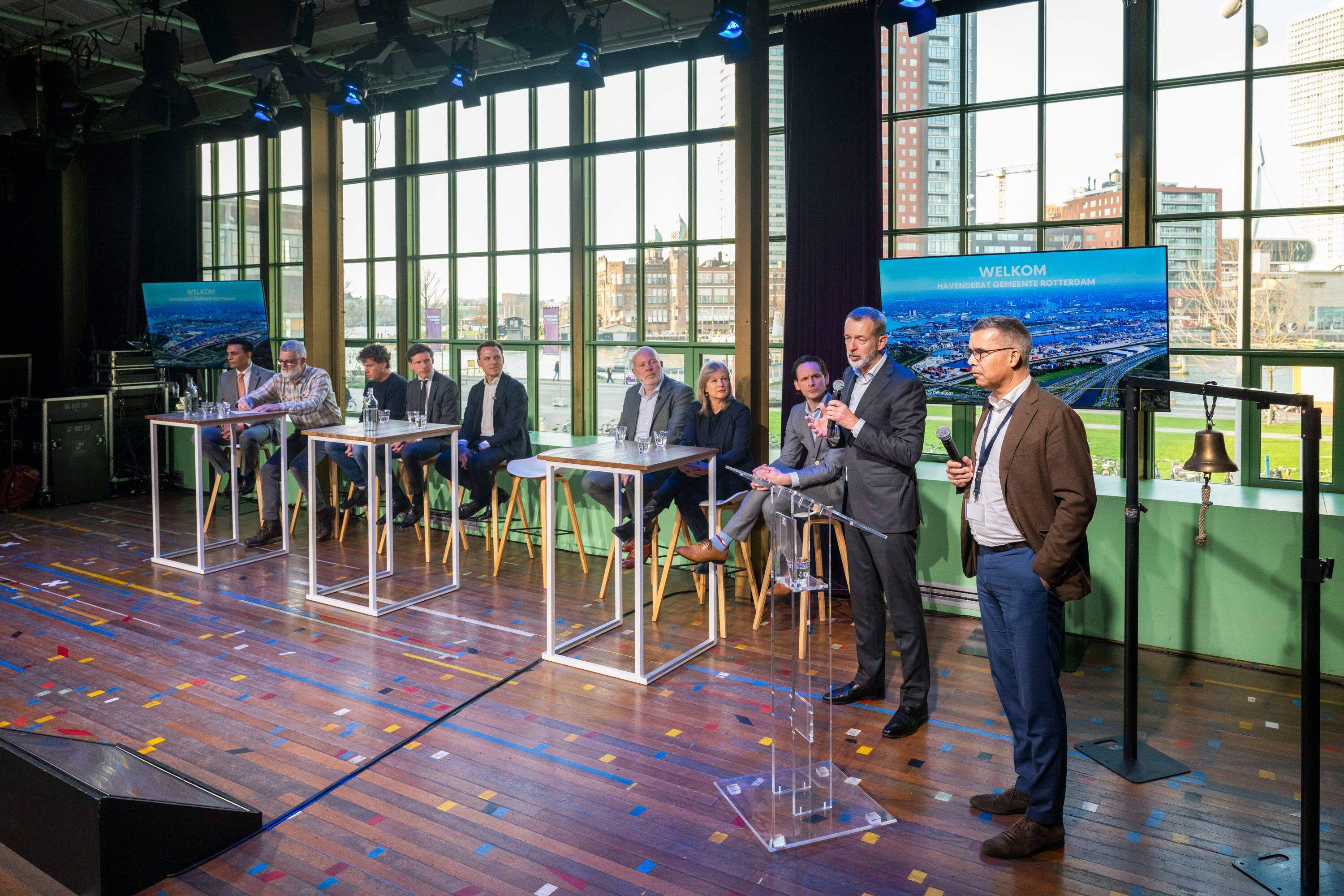
Alderman Tim Versnel (fifth from the left) during the Port Election Debate 2026
What would you like to say to a company that is considering making the transition and investing in Rotterdam?
‘If you're really choosing a location for the long term, there is hardly any better place than Rotterdam, I say with some pride. And as a city council, we are here to represent your interests. We're allies of companies that want to be part of one of the world's most advanced port industrial clusters. Of course, there is still work to do to get the necessary conditions in place, but these issues are solvable. On the other hand, our foundation is rock-solid: the location, the diversity of supply chains and the innovation ecosystem, with Erasmus University and TU Delft, vocational training and innovation campuses. You will find this combination on this scale almost nowhere else. With that in mind, we make our ambition very clear: we see 2050 as the target on the horizon, with the aim of becoming the strongest and greenest port in Europe – or even the world. We want to get people excited about that.’
Some people think that existing industry can disappear, and then something sustainable will automatically take its place. How do you see that?
‘I fundamentally disagree with that. The energy transition is not a process of decline followed by something new, but above all a process of innovation. Much of the industry that we have in the port today can become more sustainable and adapt to a new reality. That’s more efficient than making everything disappear first and then starting from scratch. Moreover, there is a risk. If we do not put the right preconditions in place for investment, this innovation will not get off the ground. Development would stagnate here, while new sustainable industry settles elsewhere. And once it takes root elsewhere, it won't come to Rotterdam by itself. That's why we need to make sure that companies can invest in the transition here.’
In the city council, there are votes for the municipality to take a more active shareholder role in the Port of Rotterdam Authority. How do you see that?
‘You can be involved as a shareholder in various ways. On the one hand, you could say: “Good luck with it, I'll read it in the annual report”. On the other, you may want to intervene in everything. There is a middle ground. You respect the company's independence, but consider it important that it delivers social and economic value for the city and the region. And you help put the preconditions in place — that's our role. We don’t want to sit in the Port of Rotterdam Authority’s seat. The organisation is in good hands under your daily management. But we see that a lot is expected of the port. As a municipality, we have a role to play in making things possible and supporting them. We want to take on that role as actively as possible. It's a more active partnership.’
Many people in Rotterdam experience the port as a world far removed from their everyday lives. Does that concern you?
‘I wouldn’t go that far, but it is something we need to change. The port is absolutely essential to our city, our region and our country. Everything we need for the good life we lead comes to us through the port. It provides energy and jobs, and puts food on the table – quite literally, the filling in your sandwich. That awareness is important. Innovation and modern port developments often take place far out of sight of the city. The vessels you see from the city centre mainly tell the story of the past. What we need to do is make the port of the future more visible. That's why I find initiatives such as the Innovation Quay during the World Port Days so valuable. Something like that should really be happening throughout the year. Then people will be inspired and young people can also discover that this is a sector with a great future.’
A question we've been wanting to ask: do you have a favourite place in the port?
‘That’s a difficult one. Over the past few months, I've seen so many places for the first time. If I have to choose, I'd say the area around the Noorderhoofd in Hoek van Holland. It’s perhaps the best place to see the enormous scale of the port. The vessels coming in, the terminals, the industry on the other side, but also the way the port connects with the surrounding natural habitats. It’s only then that you really realise how impressive this area is.’
Tim Versnel (39) — the son of a German father and Dutch mother — saw the light of day in Germany, but moved to Capelle aan den IJssel at an early age. He lives with his wife in the Afrikaanderwijk, 'op Zuid', together with their cats Willem, Frank and Edgar.
Meanwhile in
‘Globally, we are still known as an absolute A-brand’
About six months after taking office as port alderman, Tim Versnel has had the opportunity to get to know the port of Rotterdam up close. What stands out to him? The international appreciation for the port of Rotterdam and its industry, but also companies’ concerns about the investment climate. In conversation withRotterdam Port Magazine, he shares his first impressions, ambitions and vision of the municipality's role as a partner of the port.
We spoke to Versnel on the day he also had a meeting scheduled with harbour master René de Vries. The programme included a short boat trip aboard the RPA 10. Once back on shore, the port alderman beams as he walks from the pontoon near Hotel New York to the quay, where he is due to record a short interview. That grin doesn't come out of nowhere: he was allowed to steer the vessel for a while. ‘Surely that was the highlight of the day,’ Versnel exclaims.
VVD member Versnel took office as alderman for the port, economy and small communities in July. Rotterdam City Hall was by no means unfamiliar territory for him before then; from 2022 until last summer, he had already served as an alderman, with work and income and the Rotterdam-Zuid National Programme in his portfolio.
‘In that role, I visited the port frequently. It's an advantage that I already knew a lot of people there,’ says Versnel. ‘Although those discussions were mainly about the labour market and staff shortages, I was also involved in the Human Capital Coalition Energy Transition. So I already knew what the port community was doing to attract new staff, albeit from a greater distance than I do now.’
And now you are focusing on the port. You’ve spoken to a lot of people and visited many places in the port. What has stood out to you the most?
‘First of all, the port is huge and diverse, of course, with so much going on. We’re talking about shipping, logistics, industry and the challenges surrounding the energy and raw materials transition. And the more you zoom in, the more impressive it gets. For example, if you look at petrochemicals: every door you open and every system you look into turns out to be more complex than you thought. In addition, I'm really struck by the high regard in which Rotterdam is held internationally.’
Can you give an example of that?
‘I noticed that during conversations on a trade mission in Hamburg. Worldwide, we are still truly known as an absolute A-brand. That made the strongest impression on me, by far. People said that it's not just about our cluster or scale, but about our people. They are experts: professional, inventive and full of humour. There are, however, concerns about the government, energy costs and permits. But at the same time, companies say: we still want to be in Rotterdam, because you have the people. When you hear that from a CEO of a company operating around the world, you know they have a basis for comparison. At the same time, they know the bottlenecks in Rotterdam.’
Alderman Tim Versnel (third from the left) during the Port Election Debate 2026
Can you give an example of that?
‘I noticed that during conversations on a trade mission in Hamburg. Worldwide, we are still truly known as an absolute A-brand. That made the strongest impression on me, by far. People said that it's not just about our cluster or scale, but about our people. They are experts: professional, inventive and full of humour. There are, however, complaints about the government, energy costs and permits. But at the same time, companies say: we still want to be in Rotterdam, because you have the people. When you hear that from a CEO of a company operating around the world, you know they have a basis for comparison. At the same time, they know the bottlenecks in Rotterdam.’
What concerns about these bottlenecks do you hear during conversations in the port?
‘These conversations are often very candid. Practical problems come up, such as pressing concerns about infrastructure and, consequently, accessibility. Just as often, the discussions focus on the ambition to become more sustainable and keep innovating, but the preconditions must be in place to make that possible. Companies are concerned about high energy costs, unfair international competition and a lack of a level playing field in Europe. I think our companies are so good at what they do that they can withstand quite a bit of unfair competition. However, the balance has now become seriously distorted. That’s why I am also calling for better protection of our market and our companies in Brussels. That’s inevitable — and quite a tough message for me as a liberal.’
Alderman Tim Versnel (fifth from the left) during the Port Election Debate 2026
What would you like to say to a company that is considering making the transition and investing in Rotterdam?
‘If you're really choosing a location for the long term, there is hardly any better place than Rotterdam, I say with some pride. And as a city council, we are here to represent your interests. We're allies of companies that want to be part of one of the world's most advanced port industrial clusters. Of course, there is still work to do to get the necessary conditions in place, but these issues are solvable. On the other hand, our foundation is rock-solid: the location, the diversity of supply chains and the innovation ecosystem, with Erasmus University and TU Delft, vocational training and innovation campuses. You will find this combination on this scale almost nowhere else. With that in mind, we make our ambition very clear: we see 2050 as the target on the horizon, with the aim of becoming the strongest and greenest port in Europe – or even the world. We want to get people excited about that.’
Some people think that existing industry can disappear, and then something sustainable will automatically take its place. How do you see that?
‘I fundamentally disagree with that. The energy transition is not a process of decline followed by something new, but above all a process of innovation. Much of the industry that we have in the port today can become more sustainable and adapt to a new reality. That’s more efficient than making everything disappear first and then starting from scratch. Moreover, there is a risk. If we do not put the right preconditions in place for investment, this innovation will not get off the ground. Development would stagnate here, while new sustainable industry settles elsewhere. And once it takes root elsewhere, it won't come to Rotterdam by itself. That's why we need to make sure that companies can invest in the transition here.’
In the city council, there are votes for the municipality to take a more active shareholder role in the Port of Rotterdam Authority. How do you see that?
‘You can be involved as a shareholder in various ways. On the one hand, you could say: “Good luck with it, I'll read it in the annual report”. On the other, you may want to intervene in everything. There is a middle ground. You respect the company's independence, but consider it important that it delivers social and economic value for the city and the region. And you help put the preconditions in place — that's our role. We don’t want to sit in the Port of Rotterdam Authority’s seat. The organisation is in good hands under your daily management. But we see that a lot is expected of the port. As a municipality, we have a role to play in making things possible and supporting them. We want to take on that role as actively as possible. It's a more active partnership.’
Many people in Rotterdam experience the port as a world far removed from their everyday lives. Does that concern you?
‘I wouldn’t go that far, but it is something we need to change. The port is absolutely essential to our city, our region and our country. Everything we need for the good life we lead comes to us through the port. It provides energy and jobs, and puts food on the table – quite literally, the filling in your sandwich. That awareness is important. Innovation and modern port developments often take place far out of sight of the city. The vessels you see from the city centre mainly tell the story of the past. What we need to do is make the port of the future more visible. That's why I find initiatives such as the Innovation Quay during the World Port Days so valuable. Something like that should really be happening throughout the year. Then people will be inspired and young people can also discover that this is a sector with a great future.’
A question we've been wanting to ask: do you have a favourite place in the port?
‘That’s a difficult one. Over the past few months, I've seen so many places for the first time. If I have to choose, I'd say the area around the Noorderhoofd in Hoek van Holland. It’s perhaps the best place to see the enormous scale of the port. The vessels coming in, the terminals, the industry on the other side, but also the way the port connects with the surrounding natural habitats. It’s only then that you really realise how impressive this area is.’
Tim Versnel (39) — the son of a German father and Dutch mother — saw the light of day in Germany, but moved to Capelle aan den IJssel at an early age. He lives with his wife in the Afrikaanderwijk, 'op Zuid', together with their cats Willem, Frank and Edgar.