For an overview of all construction work,
visit our website
Scroll down
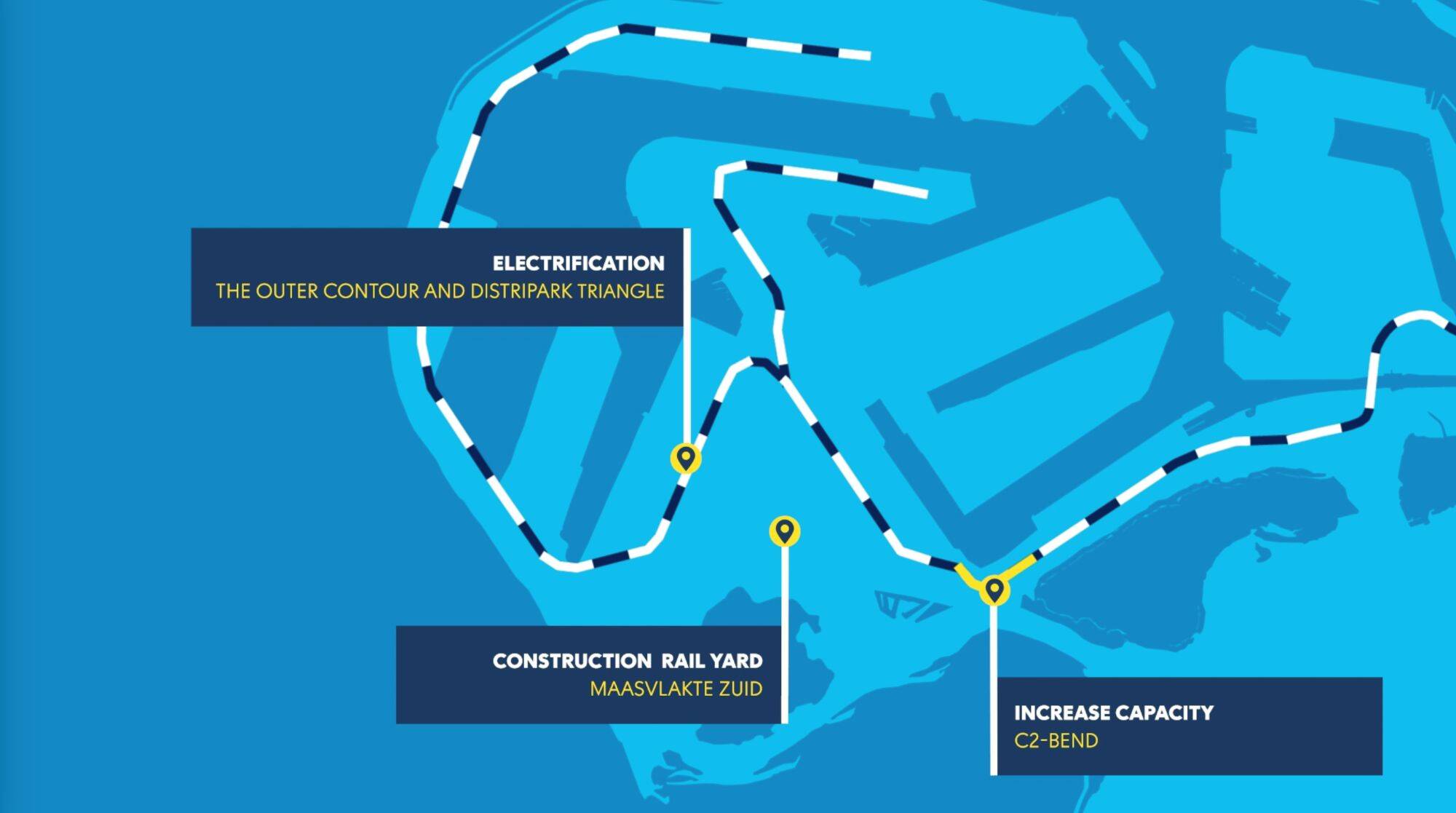
The railway yard will be able to process 740-metre-long freight trains. That is considerably longer than the current standard length of approximately 600 meters. The longer trains offer a number of advantages, allowing more containers to be transported in a single trip. This means fewer train movements, lower emissions, and reduced costs per tonne of freight. Various infrastructure projects are planned until 2040 to improve rail accessibility to the Maasvlakte. In addition to the construction of the new railway yard with four bundles of six tracks each, the total development includes electrification of the distribution triangle and the outer contour, modification of the C2-curve and realisation of two through tracks. These developments are in line with the Port Authority’s aim to stimulate rail freight transport. Thanks to the railway yard, the Port Authority expects to run an additional 6,750 trains annually between the Maasvlakte and the hinterland, equating to replacing 675,000 lorry journeys per year.
Future-proof port
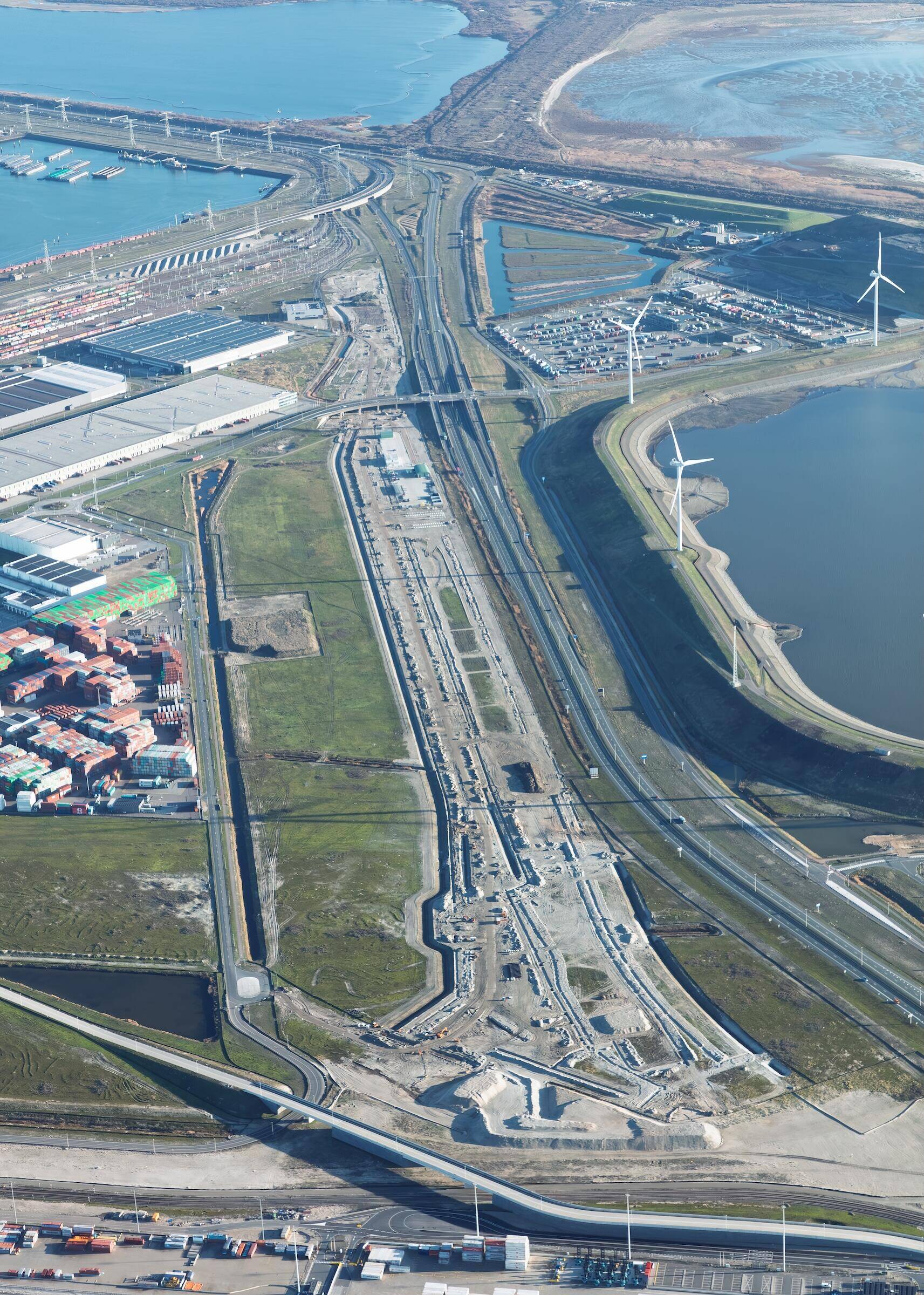
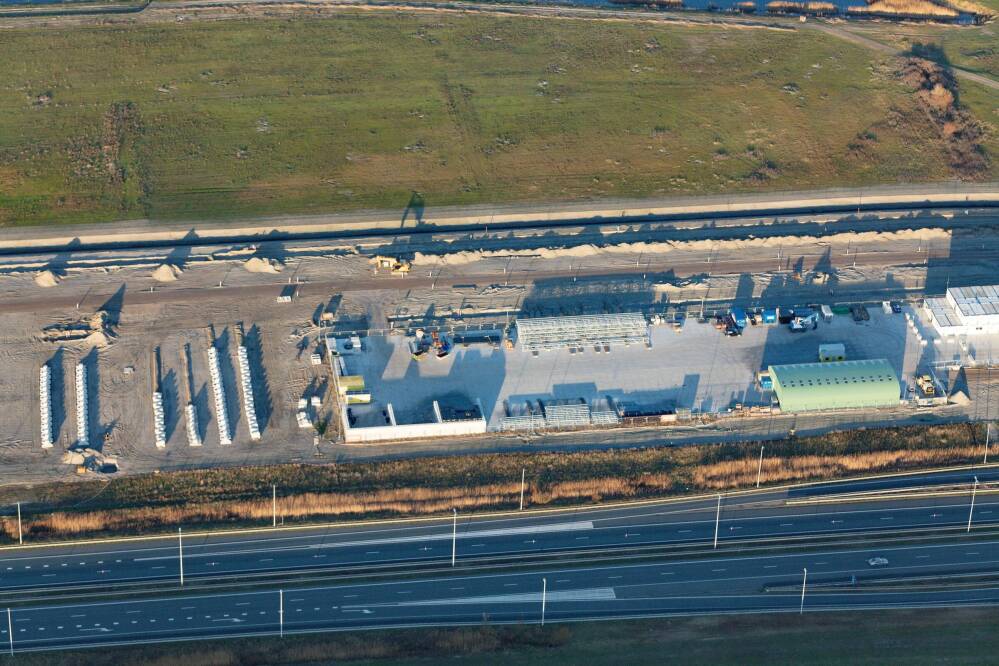
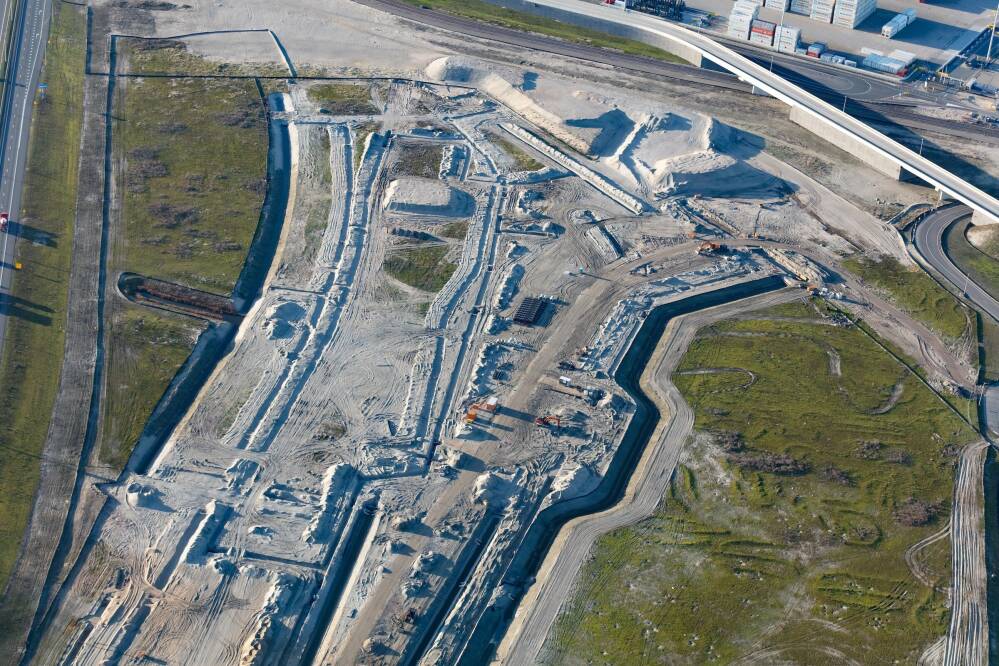
In collaboration with ProRail, the Port of Rotterdam Authority is currently implementing the first phase of the new railway yard. The yard will be built in phases. This phase includes the construction of the first bundle of six tracks and various connections to the existing railway infrastructure. During the preparatory phase, a large number of existing cables and pipes had to be rerouted because the new railway junction crosses the existing pipeline corridor in several places. Concrete underground structures have also been constructed. These structures ensure that future cable and pipeline routes are ‘covered’. This limits disruption ‘above ground’, with a pipeline conduit providing a passageway under the railway track. The underground structures make it possible to lay pipes for new energy transition projects under the railway lines without causing any disruption. Following these preparatory works, contractor Swietelsky Rail Benelux officially commenced construction of the first set of tracks in October 2025. This first bundle will be put into service in mid-2027. The majority of the work will take place this year. After the test phase, mid-2027 the yard will be transferred to ProRail. ProRail will then commission the railway yard and commence operations. A total of 50,000 tonnes of ballast, 22,248 metres of rail, 34 points and 17,079 sleepers will be used to construct the yard.
To ensure the port of Rotterdam remains accessible and future-proof, the Port of Rotterdam Authority, ProRail and the Ministry of Infrastructure & Water Management are investing in sustainable and efficient rail infrastructure. The construction of the new Maasvlakte Zuid railway yard is a good example of this. A railway yard is needed for shunting, parking, assembling and delivering trains to the terminal where the train is to be loaded or unloaded. There are already several railway yards along the 40-kilometre-long Port Railway Line (Havenspoorlijn) in the port of Rotterdam. These include Botlek, Waalhaven, Maasvlakte West and Kijfhoek in Zwijndrecht, the largest in the Netherlands. These assorted railway yards along the Port Railway Line connect the port with the European hinterland.
In the coming years, the flow of containers will increase due to economic and population growth. To continue transporting the ever-increasing flow of containers to and from the hinterland efficiently, it is crucial to utilise all available modes of transport. This is largely achieved through road transport. Analyses have shown that around 40% of containers travelling to and from the Maasvlakte originate in or are destined for the port area, and another 30% across the Rotterdam region. Rail and inland waterway transport are not suitable modes of transport for these short distances. For longer distances, transport by water or rail becomes an attractive option. Efficient and accessible international rail connections with short transit times from ports and industrial clusters are of paramount importance for the economy and society and provide a competitive advantage for the Netherlands. These are key prerequisites for our seaports, and thus for the Dutch economy. Rail freight transport enables Rotterdam to reach markets in southern Germany, Austria, Switzerland and Central Europe safely, reliably and sustainably.
Every year, around 14 million containers are handled in the port of Rotterdam. These containers carry a wide range of freight. Such as food, parts for machines or cars, semi-manufactured products, clothing and furniture. Just about everything you see around you in terms of finished goods has at some point entered the country via a container. The import and export of this freight and these raw materials is therefore important for businesses and consumers in both the Netherlands and Europe, and thus for European prosperity.
Construction
Railway bottlenecks on the Maasvlakte
Accessibility of the Maasvlakte
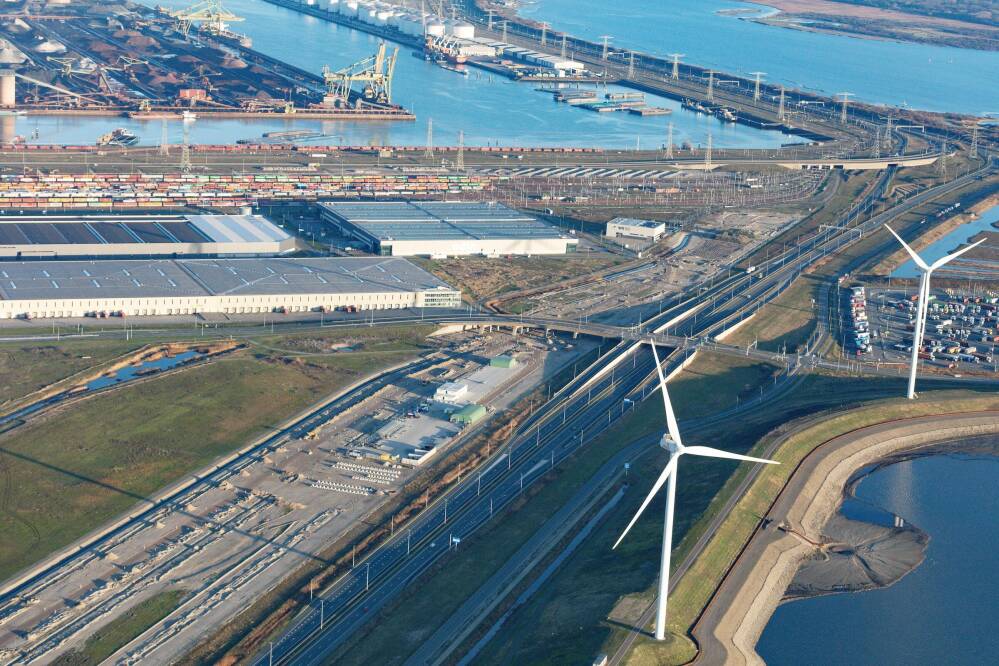
In the south-western corner of the Maasvlakte, work is currently underway on the construction of a brand-new railway yard. Next year the first 740-metre trains will arrive at this site, enclosed between the Maasvlakte West Distribution Park and De Slufter. Why is this railway yard being constructed and what does the construction involve? We’ll be explaining that in this article.
Maasvlakte-Zuid Railway Yard
BUILDING THE FUTURE
To ensure the port of Rotterdam remains accessible and future-proof, the Port of Rotterdam Authority, ProRail and the Ministry of Infrastructure & Water Management are investing in sustainable and efficient rail infrastructure. The construction of the new Maasvlakte Zuid railway yard is a good example of this. A railway yard is needed for shunting, parking, assembling and delivering trains to the terminal where the train is to be loaded or unloaded. There are already several railway yards along the 40-kilometre-long Port Railway Line (Havenspoorlijn) in the port of Rotterdam. These include Botlek, Waalhaven, Maasvlakte West and Kijfhoek in Zwijndrecht, the largest in the Netherlands. These assorted railway yards along the Port Railway Line connect the port with the European hinterland.
Railway bottlenecks on the Maasvlakte
The railway yard will be able to process 740-metre-long freight trains. That is considerably longer than the current standard length of approximately 600 meters. The longer trains offer a number of advantages, allowing more containers to be transported in a single trip. This means fewer train movements, lower emissions, and reduced costs per tonne of freight. Various infrastructure projects are planned until 2040 to improve rail accessibility to the Maasvlakte. In addition to the construction of the new railway yard with four bundles of six tracks each, the total development includes electrification of the distribution triangle and the outer contour, modification of the C2-curve and realisation of two through tracks. These developments are in line with the Port Authority’s aim to stimulate rail freight transport. Thanks to the railway yard, the Port Authority expects to run an additional 6,750 trains annually between the Maasvlakte and the hinterland, equating to replacing 675,000 lorry journeys per year.
For an overview of all construction work,
visit our website
Future-proof port
In collaboration with ProRail, the Port of Rotterdam Authority is currently implementing the first phase of the new railway yard. The yard will be built in phases. This phase includes the construction of the first bundle of six tracks and various connections to the existing railway infrastructure. During the preparatory phase, a large number of existing cables and pipes had to be rerouted because the new railway junction crosses the existing pipeline corridor in several places. Concrete underground structures have also been constructed. These structures ensure that future cable and pipeline routes are ‘covered’. This limits disruption ‘above ground’, with a pipeline conduit providing a passageway under the railway track. The underground structures make it possible to lay pipes for new energy transition projects under the railway lines without causing any disruption. Following these preparatory works, contractor Swietelsky Rail Benelux officially commenced construction of the first set of tracks in October 2025. This first bundle will be put into service in mid-2027. The majority of the work will take place this year. After the test phase, mid-2027 the yard will be transferred to ProRail. ProRail will then commission the railway yard and commence operations. A total of 50,000 tonnes of ballast, 22,248 metres of rail, 34 points and 17,079 sleepers will be used to construct the yard.
Construction
In the coming years, the flow of containers will increase due to economic and population growth. To continue transporting the ever-increasing flow of containers to and from the hinterland efficiently, it is crucial to utilise all available modes of transport. This is largely achieved through road transport. Analyses have shown that around 40% of containers travelling to and from the Maasvlakte originate in or are destined for the port area, and another 30% across the Rotterdam region. Rail and inland waterway transport are not suitable modes of transport for these short distances. For longer distances, transport by water or rail becomes an attractive option. Efficient and accessible international rail connections with short transit times from ports and industrial clusters are of paramount importance for the economy and society and provide a competitive advantage for the Netherlands. These are key prerequisites for our seaports, and thus for the Dutch economy. Rail freight transport enables Rotterdam to reach markets in southern Germany, Austria, Switzerland and Central Europe safely, reliably and sustainably.
Accessibility of the Maasvlakte
Maasvlakte-Zuid Railway Yard
In the south-western corner of the Maasvlakte, work is currently underway on the construction of a brand-new railway yard. Next year the first 740-metre trains will arrive at this site, enclosed between the Maasvlakte West Distribution Park and De Slufter. Why is this railway yard being constructed and what does the construction involve? We’ll be explaining that in this article.
BUILDING THE FUTURE
Every year, around 14 million containers are handled in the port of Rotterdam. These containers carry a wide range of freight. Such as food, parts for machines or cars, semi-manufactured products, clothing and furniture. Just about everything you see around you in terms of finished goods has at some point entered the country via a container. The import and export of this freight and these raw materials is therefore important for businesses and consumers in both the Netherlands and Europe, and thus for European prosperity.